
Services
Roofing Services in Bournemouth
Six services, all carried out by Coastline's own team. Each one is set out in full below — what the work covers, the symptoms that point to it, and the detail that decides whether it lasts.
- New Roofs & Re-Roofing
- Roof Repairs & Leaks
- Flat Roofing
- Chimneys & Leadwork
- Fascias, Soffits & Guttering
- Roof Cleaning & Moss Removal
01 New Roofs
New Roofs & Re-Roofing in Bournemouth
A new roof is the biggest single thing you will ever do to the outside of your house, and the part you can see is the smallest part of the job. What decides whether it lasts fifty years or fifteen is everything underneath.
When Coastline strip a roof in Bournemouth, the covering comes off first and the rafters get looked at properly. Houses around Winton, Moordown and Charminster tend to be inter-war and post-war stock with sawn softwood rafters, and after eighty years of a leaking valley or a slipped tile there is usually at least one rafter foot or wall plate that has gone soft. That gets cut out and spliced before anything new goes on, because a new covering laid over rotten timber is a new roof that sags.
Then the roof is felted and battened. Modern breathable underlay replaces the old bitumen felt, which is what has usually perished and started dropping black crumbs into the loft. Battens are graded and treated, gauged to the headlap the tile or slate actually needs rather than to whatever the last roofer had in the van, and the eaves get a proper eaves carrier so water runs into the gutter instead of behind it.
The covering goes on last, and on the exposed south-coast pitches around Southbourne, Boscombe and the clifftop roads it is mechanically fixed far more heavily than an inland roof would be. Ridges and hips are dry-fixed rather than bedded in sand and cement, which is the single biggest change in British roofing in the last twenty years: a mortar ridge cracks, lets water in and eventually blows off, and Building Regulations have required mechanical fixing on new work since 2015.
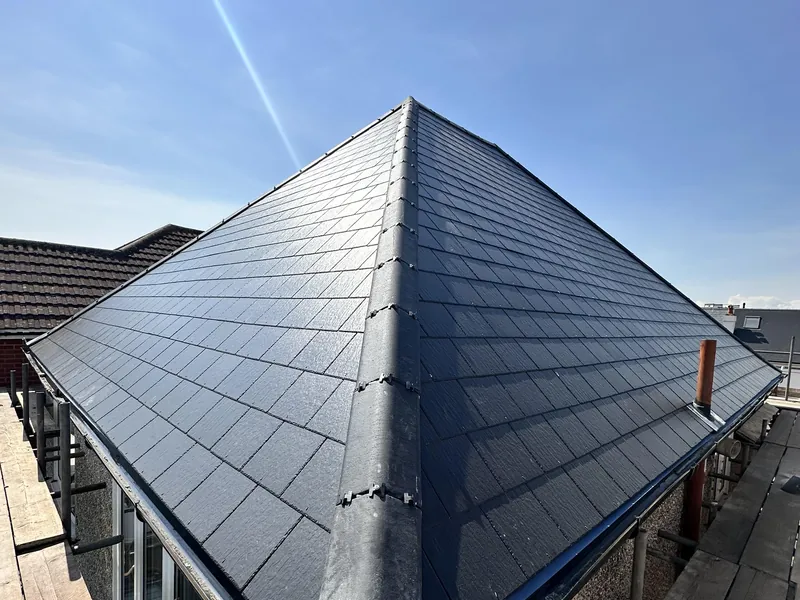
What a full re-roof includes
- Strip and safe removal of the old covering
- Full inspection of rafters, wall plates and purlins
- Replacement of any rotten or split timbers
- New breathable underlay throughout
- New treated battens, gauged to the covering
- Slate, plain tile, interlocking tile or a match to the existing
- Dry-fix ridge, hip and verge systems
- New lead valleys, soakers and abutment flashings
- Eaves protection, ventilation and a new eaves course
- Scaffold, sheeting and a cleared site at the end
Signs your roof needs replacing rather than patching
Repairs that keep coming back
One slipped slate is a repair. The fourth one this year in a different place usually means the nails have rusted through across the whole roof.
Black grit in the loft or the gutters
That is the old bitumen felt breaking down. Once the underlay has gone, every bit of wind-driven rain that gets past a tile is inside the roof.
Daylight through the boarding
Visible gaps along a rafter line mean the covering has lifted or the underlay has torn, and both let water track a long way before it shows.
A dipped or wavy ridge line
Sight along the ridge from the street. A dip means a rafter, purlin or wall plate has moved, and that is structural, not cosmetic.
Spalling, laminating or drummy tiles
Concrete tiles that have lost their surface and slates that flake apart in layers are at the end of their life and will not hold a fixing.
A roof over about sixty years old
Not a fault on its own, but combined with any of the above it usually makes re-roofing the cheaper answer over ten years.
Why the detail underneath matters more than the tile
Most roof failures that Coastline get called to are not failures of the tile at all. They are failures of a junction — a valley, an abutment, a chimney or a verge. Those are the places where two planes meet and where water has to be steered rather than simply shed, and they are the places a cheap re-roof quietly economises on.
The commonest example on the south coast is the cement fillet. Instead of dressing lead into a chase in the brickwork, a sand-and-cement fillet is smeared where the roof meets the wall. It looks tidy for about three years, then it cracks, because mortar and the roof move at different rates and mortar has no give. Water then runs behind it and into the wall, and it is almost always the cause when a chimney breast goes damp indoors.
Ventilation is the other one. A modern breathable membrane still needs air moving through the roof space, at the eaves and usually at the ridge too. Seal a loft up tight — which happens every time someone lays insulation straight over the eaves without a ventilation tray — and the moisture that your house produces condenses on the cold underside of the roof. People report that as a leak, in dry weather, and it is not one.
New Roofs — common questions
How long does a new roof take in Bournemouth?
Most ordinary houses take between three and seven days once the scaffold is up. A larger or cut-and-pitch roof, or one that needs structural timber work, takes longer. Weather is the other variable — a roof is never left open overnight, so a wet week stretches the programme.
Will I need scaffolding for a new roof?
Yes. A full re-roof always needs a scaffold: it is the only safe way to strip and load out a roof, and it is what makes a proper job at the eaves and verges possible. Smaller repairs can often be done off ladders or a tower instead.
Can you match my existing tiles?
Usually. Many concrete and clay profiles are still made, and where one has been discontinued there is normally a close current equivalent, or reclaimed stock. On a semi-detached or terraced house, matching the neighbour matters, so it is worth discussing at the estimate.
Do I need planning permission to replace my roof?
Replacing like for like is normally permitted development. You do need to meet Building Regulations, and if you change the roof covering to something significantly heavier or lighter, or you live in a conservation area or a listed building, the answer changes. Coastline will tell you which applies before any work starts.
What guarantee comes with a new roof?
Depending on the materials specified, manufacturer warranties are available alongside a workmanship guarantee. Coastline state that the materials they use are backed by manufacturer warranties of up to 20 years — ask for the specific cover in writing with your estimate, as it varies by product.
02 Roof Repairs
Roof Repairs & Leaks in Bournemouth
Nearly every roof leak is a small fault in an awkward place. The skill is not the repair, it is finding which of six possible faults is actually putting the water on your ceiling.
Water almost never comes through the roof directly above the damp patch. It gets in at a high point, runs down the underside of the membrane or along a rafter, and drops off wherever the timber stops being level. A stain in the middle of a back bedroom ceiling in Southbourne routinely turns out to be a cracked flashing at the chimney two metres up the slope, or a blocked valley three metres across.
So a repair starts with an inspection rather than a guess. That means looking in the loft as well as on the roof, in daylight, for the tell-tale run marks on rafters and the dark staining on the underside of the boards that shows where water has actually travelled. Tracing it properly is what stops you paying for the same ceiling twice.
Storm damage on the coast is its own category. Bournemouth and Christchurch take the full south-westerlies, and what usually goes is the verge, the ridge and the dry-fix clips at the exposed gable. If tiles are on the lawn after a gale, the priority is making the roof safe and watertight the same visit; a temporary cover is often the right first move while a permanent repair is arranged.
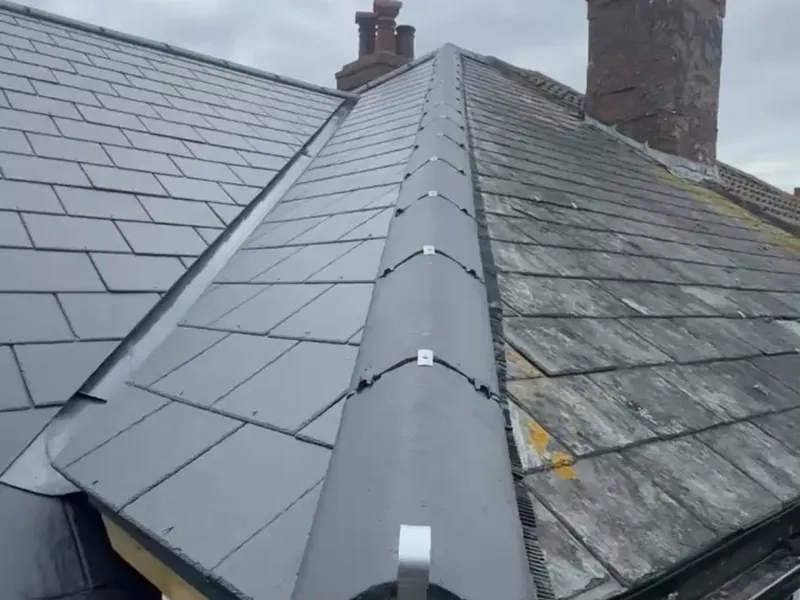
Repairs Coastline carry out
- Leak tracing and full roof inspection
- Slipped, cracked and missing slates or tiles
- Storm damage and emergency make-safe
- Ridge and hip re-bedding or dry-fix conversion
- Cracked or lifted lead flashing and soakers
- Blocked, leaking and failed valleys
- Perished felt at the eaves and verge repairs
- Chimney-related water ingress
Symptoms worth acting on now
A damp patch that grows after rain
An active leak. The longer it runs the more plaster, insulation and timber it spoils, and the bigger the repair gets.
Tiles or slates on the ground
The roof has already failed somewhere. What is loose next is the question, and a gale will answer it.
Staining around the chimney breast
Almost always a flashing or a cement fillet, not the chimney itself. Cheap to fix at this stage, expensive once the wall is saturated.
Water coming in only in driving rain
Classic wind-driven ingress at a verge, an abutment or a torn membrane — it will not show on a wet but still day.
Gutters overflowing down the wall
Not strictly a roof leak, but it wets the wall and rots the fascia, and it is often the cheapest thing on this list to put right.
What a proper leak diagnosis looks like
There are really only a handful of ways water gets into a pitched roof, and a roofer who knows them can usually narrow it down before climbing anything. Broken or slipped covering. A failed junction — valley, abutment, chimney, or a soil vent pipe. A perished underlay letting normal wind-blown water through. A blocked gutter or valley backing water up under the tiles. Or condensation, which is not a leak at all.
The one that gets misdiagnosed most often is condensation. It shows up in cold, dry, still weather, it wets a wide area rather than running from one point, and it is worst over bathrooms and kitchens. Replacing tiles will not touch it. What fixes it is ventilation and stopping warm moist air getting into the roof space in the first place.
The second most common misdiagnosis is the chimney. Water appearing on a chimney breast usually comes from the flashing, the flaunching at the top, open joints in the stack itself, or a redundant flue with no cap letting rain straight down. Each has a different fix, and sealing the roof around the stack does nothing for three of the four.
Roof Repairs — common questions
Do you do emergency roof repairs?
Yes. Coastline carry out emergency work for storm damage, sudden leaks and fallen tiles, and can often make a roof safe and temporarily watertight on the first visit while a permanent repair is arranged. Call 07921 856517 and describe what has happened.
Is it cheaper to repair or replace my roof?
If the problem is isolated — one junction, a run of slipped tiles, a failed flashing — repairing is far cheaper and entirely sensible. If the same roof keeps failing in new places, the fixings or the underlay have generally reached the end of their life and repairs stop being good value.
Why is water coming through my ceiling when it rains?
Because something on the roof is letting it past, and it has travelled along a rafter before dropping. The stain marks where it falls, not where it gets in — which is why a proper inspection looks in the loft as well as on the roof.
Can you repair a leaking garage or extension roof?
Yes. Flat garage and extension roofs are one of the commonest repairs, and depending on the condition of the deck a patch repair, an overlay or a full new covering may be the right answer.
03 Flat Roofing
Flat Roofing in Bournemouth
A flat roof is not flat. Every one that lasts has a fall built into it, and the ones that fail almost always failed at the design stage, not the material.
Flat roofs get a bad name from a generation of single-layer mineral felt laid on chipboard in the 1970s, which did indeed last about eight years. The materials now available are a different proposition: a properly specified GRP, EPDM or torch-on system on a sound, ventilated deck with the right fall will run for decades.
The deck is where Coastline start. Chipboard has no place on a flat roof and never did — it delaminates as soon as it gets damp. Exterior-grade plywood or OSB3 is the minimum, laid with the right expansion gaps and fixed at the right centres. If the existing deck has been wet, it comes off, because nothing bonded to a soft deck stays bonded.
Then the fall. A flat roof needs a minimum finished fall of 1 in 80, which in practice means designing to 1 in 40 so that deflection and settlement do not leave you with a level roof and standing water. Ponding is what kills flat roofs: it holds water against every seam and detail continuously instead of for the few minutes it takes to drain.
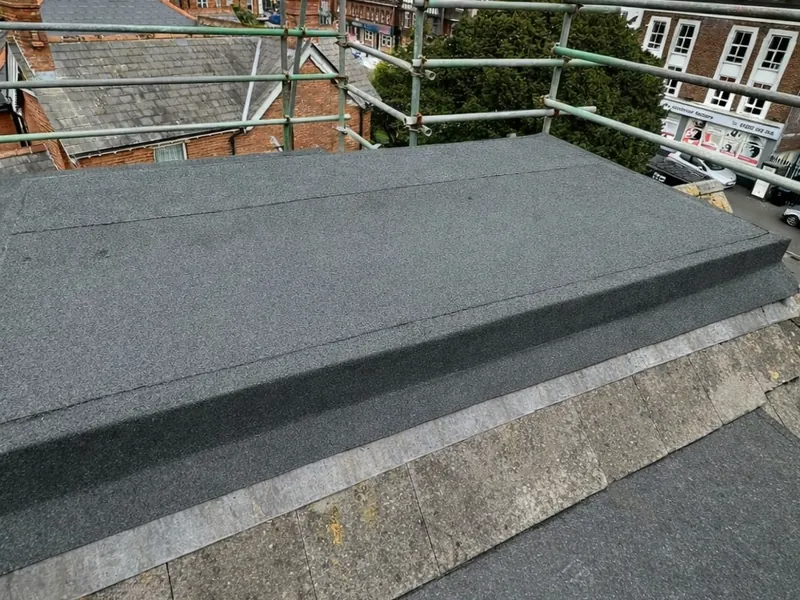
Flat roofing Coastline install and repair
- GRP fibreglass roofing, laid wet in one seamless piece
- EPDM rubber membrane, single-sheet on most domestic roofs
- Torch-on felt systems, two and three layer
- New decking in exterior-grade ply or OSB3
- Firrings to build in or correct the fall
- GRP or aluminium trims, drips and edge details
- New outlets, rainwater pipes and overflow provision
- Upstands, kerbs and abutment detailing
- Warm and cold deck build-ups with proper ventilation
- Repairs, patches and overlays where the deck is sound
Signs a flat roof needs attention
Water standing days after rain
Ponding. It means the fall has gone or was never there, and it will find every seam eventually.
Blisters or bubbles in the surface
Moisture trapped under the membrane, expanding in the sun. Each blister is a weak point waiting to split.
Splits at the upstands or corners
Movement. The detail has been stretched past what it can take, usually where the covering turns up a wall.
A deck that gives underfoot
The boards are wet and delaminating. A new covering over that is money thrown away — the deck has to come off.
Green growth and silt across the surface
The roof is not draining and is not being cleared. Both shorten its life and both are easy to put right.
GRP, EPDM or felt — which is right
GRP fibreglass is laid wet and cures into one seamless sheet with no joints anywhere, including up the upstands and over the trims. That makes it excellent on complex shapes, balconies and anything that will be walked on. It needs dry weather and a temperature window to lay, and it is rigid, so the deck below it has to be genuinely solid.
EPDM rubber goes down as a single sheet on most domestic-sized roofs, so it also has no field joints, and it stays flexible across a very wide temperature range. That flexibility makes it forgiving of building movement. It is the usual choice for a straightforward garage or extension roof, and it can be laid in weather that GRP cannot.
Torch-on felt has moved a long way from the 1970s product people remember. A modern two or three layer SBS-modified system, with a proper mineral cap sheet, is tough, repairable and well suited to larger or more heavily detailed commercial roofs where sheets have to be joined anyway. It is also the easiest of the three to patch locally in years to come.
Flat Roofing — common questions
How long does a flat roof last?
A properly specified and installed flat roofing system typically lasts between twenty and forty years depending on the product, the deck and how well it drains. The failures that happen much sooner than that are almost always a fall problem or a deck problem rather than the membrane itself.
Can you lay a new flat roof over the old one?
Sometimes. If the deck is dry and sound and the existing covering is stable, an overlay can be the right call. If the deck has been wet, stripping is the only option that lasts — Coastline will open it up and tell you which you are dealing with.
Which is better, GRP or EPDM?
Neither is better in general; they suit different roofs. GRP is seamless and hard-wearing and suits balconies and complex shapes. EPDM is flexible, quick and forgiving of movement, and suits straightforward garages and extensions. The shape of your roof and the weather that week usually decide it.
Can you repair a flat roof instead of replacing it?
Yes, where the deck underneath is still sound. Splits, blisters and failed upstands can all be repaired locally. Coastline check the deck first, because a repair over soft boards does not hold.
04 Chimneys & Leadwork
Chimneys & Leadwork in Bournemouth
The chimney is the most exposed masonry on your house, wet on all four sides, and it is behind a large share of the damp that gets blamed on the roof.
A stack takes weather from every direction and has nothing above it. On the coast that is a harder life than the same brickwork would have inland — salt-laden air, constant wind loading and driving rain on the windward face. Joints open up, the flaunching at the top cracks, and water starts getting into the stack rather than running off it.
Once water is in the brickwork it travels down and comes out where it can, which is usually on the chimney breast in a bedroom. That damp reads as a roof leak, and people spend money on the roof around the stack when the problem is the stack itself. Repointing, a new flaunching and a cap or cowl on a redundant flue often solves it entirely.
Where the stack has gone too far, it gets rebuilt — taken down to a sound course and built back up in matching brick, with the flue liner and pots reset and new lead dressed in as the work comes back through the roof line. That is the photograph on this page: new brickwork, the liner reinstated and the pot back on.
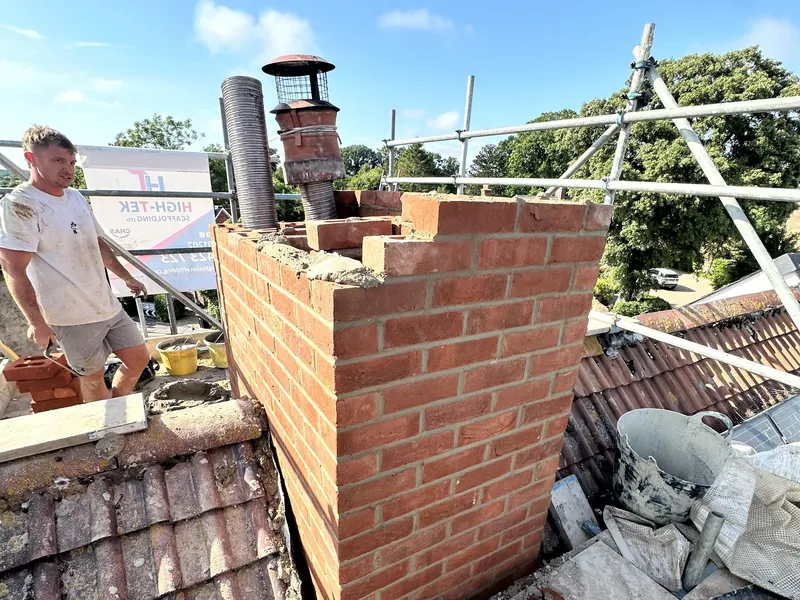
Chimney and lead work
- Repointing to open and weathered joints
- Partial and full stack rebuilds in matching brick
- New flaunching and pot re-bedding
- Caps, cowls and capping of redundant flues
- Removal of stacks and making good the roof
- Code-appropriate lead flashings, soakers and aprons
- Lead-lined valleys and secret gutters
- Stepped and raked flashings chased into brickwork
- Replacement of failed cement fillets with proper lead
Chimney problems worth catching early
Damp on a chimney breast indoors
The single commonest symptom, and rarely the roof. Flashing, flaunching or open joints are the usual three.
Crumbling mortar you can rake out by hand
The joints have lost their weathering. Repointing at this stage is straightforward; leaving it turns it into a rebuild.
A cracked or missing flaunching
The mortar bed the pots sit in. Once it cracks, rain goes straight down inside the stack.
A leaning stack or stepped cracking
Structural. Worth looking at quickly, particularly on an exposed gable.
A cement fillet instead of lead
A cheap substitute for a flashing. It always cracks in the end, and it is behind a lot of chimney-breast damp.
Why lead, and why it has to be dressed properly
Lead is used at roof junctions because it does something no other common material does: it can be worked cold into a complicated three-dimensional shape and then stay there, moving with the building for a century without fatiguing — provided it is detailed correctly. Almost every failed flashing has failed because the detailing was wrong, not the material.
The two rules that get broken are code and length. Lead comes in codes by thickness, and using too thin a code for the exposure means it tears. Using pieces that are too long means it cannot expand and contract, so it splits along a fold — which is why a flashing is run in short lapped pieces rather than one continuous strip, and why a long, neat, single-piece flashing is usually a sign of a job that will fail.
The other thing that matters is where it is fixed. A stepped flashing is chased into a mortar joint and wedged, then pointed — it is not stuck on the face of the brickwork with sealant. Sealant fails in a few summers of UV; a chased and wedged flashing does not need to be touched again for decades.
Chimneys & Leadwork — common questions
Can you repair leaking lead flashing around my chimney?
Yes, and it is one of the jobs Coastline are called out for most. Depending on the condition, the flashing is either re-dressed and re-pointed or replaced in the correct code of lead.
My chimney is not used any more — should I remove it?
Not necessarily. Capping it with a ventilated cowl keeps rain out while still letting the flue breathe, which is much cheaper than removal and avoids the damp that a fully sealed flue can cause. Removal makes sense if the stack is unsound or you want the space.
What is flaunching and why does it matter?
It is the sloped mortar bed at the top of the stack that holds the pots and sheds water off the top. When it cracks, rain runs straight into the stack, and it is one of the cheapest things on a roof to put right.
Do you repair or replace damaged ridge tiles?
Both. Individual ridge tiles can be re-bedded, but where the mortar has failed along a whole run, converting to a dry-fix ridge system is more durable and is what current Building Regulations expect on new work.
05 Roofline & Guttering
Fascias, Soffits & Guttering in Bournemouth
The roofline is the strip where the roof hands water over to the drainage. Get it wrong and you soak the wall every time it rains, with no dramatic leak to tell you.
Fascia, soffit and gutter do three jobs between them: they carry the gutter, they close off the eaves against birds and wind while still letting air in, and they throw water clear of the wall. When the fascia softens, the gutter brackets lose their hold, the gutter drops out of level, and water runs down the wall behind it rather than along the pipe.
That wet strip of wall is what eventually shows up inside as damp at the top of an upstairs wall, and it is one of the most misdiagnosed problems in housing. It is also, by some distance, the cheapest of the roof-related faults to put right — provided it is caught before the wall plate and rafter feet get involved.
Coastline also fit roof windows, which sit in the same category of work: a hole cut into a finished roof that has to be made permanently watertight. The flashing kit has to suit the covering — a flat slate and a deep-profile interlocking tile need different kits — and the trimming underneath has to carry the load the cut rafter was carrying.
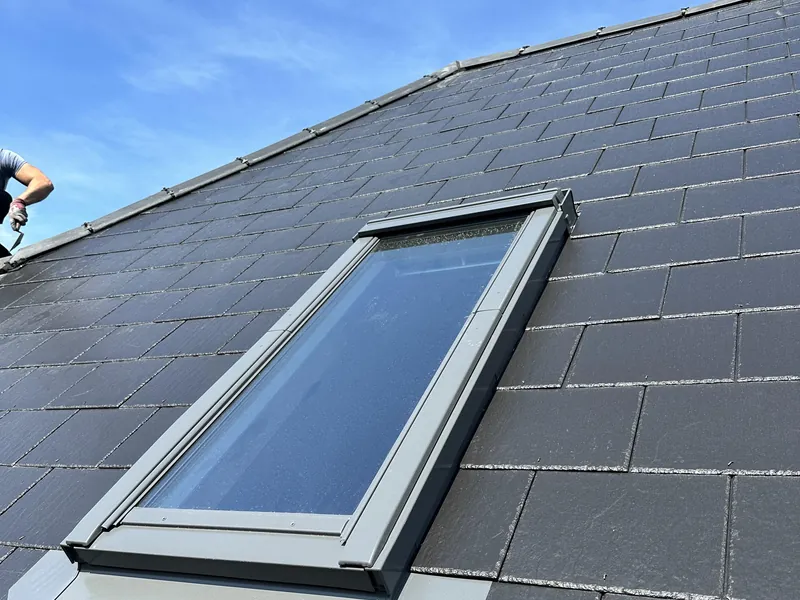
Roofline work
- uPVC fascia and soffit replacement
- Capping over sound timber fascias where appropriate
- New guttering, running outlets and downpipes
- Gutter re-levelling, re-bracketing and leak repairs
- Gutter clearing and downpipe unblocking
- Ventilated soffits and over-fascia ventilation
- Bargeboards and verge trims
- Roof window and rooflight installation
- Flashing kits matched to the roof covering
Roofline symptoms
Water sheeting down the wall in rain
The gutter is blocked, split or out of level. The wall is getting wet every time it rains.
A green or black streak below the gutter line
Long-term overflow. It has been happening for years, not weeks.
Soft, flaking or lifting fascia board
Rot. The gutter brackets are fixed to that board, so it is only a matter of time before the gutter moves.
Plants growing out of the gutter
There is enough silt in there to hold a root. Nothing is draining.
Birds getting into the eaves
The soffit has a gap. It also means the eaves ventilation path is probably disturbed.
Capping versus replacing, and why it matters
There are two ways to make an old timber fascia look new. One is to replace the board entirely with a full-thickness uPVC fascia fixed back to the rafter feet. The other is capping: leaving the old timber in place and wrapping a thin plastic sheet over the face of it.
Capping is legitimate and much cheaper — when the timber underneath is genuinely sound and dry. Over rotten timber it is one of the worst things you can do, because it hides the rot, holds moisture against it, and leaves the gutter brackets screwed into wood that is already failing. From the ground it looks like a brand new roofline for about five years.
The honest version of this job is to open it up, look at the timber, and say which you are dealing with. Where the fascia is sound, capping saves real money. Where it is not, replacing is the only thing worth paying for, and it is the moment to check the rafter feet and the wall plate as well while they are visible.
Roofline & Guttering — common questions
Do you replace fascias, soffits and guttering?
Yes, across Bournemouth, Christchurch and Poole, in uPVC to match the house. Coastline will also tell you honestly whether your existing timber needs full replacement or whether capping is genuinely appropriate.
Can you fix leaking gutters and downpipes?
Yes. Most gutter leaks are a failed seal at a joint, a cracked section or a gutter that has dropped out of level, and all three are straightforward to put right without replacing the whole run.
How often should gutters be cleared?
Once a year for most houses, and twice where there are trees close by. It is a small job that prevents a much larger one, because an overflowing gutter wets the wall and rots the fascia behind it.
Can you fit a roof window into my existing roof?
Yes. A rooflight can be installed into an existing pitched roof, with the rafters trimmed properly and a flashing kit matched to your covering so the junction stays watertight.
06 Roof Cleaning
Roof Cleaning & Moss Removal in Bournemouth
Moss is not just untidy. It holds water against the tile, blocks the valleys and dams the gutters, and the wrong way of removing it does more harm than leaving it alone.
The south-coast climate suits moss: mild, damp and with plenty of shaded north-facing pitches. On a concrete interlocking tile it colonises the surface; in a valley it builds into a mat that holds standing water exactly where the roof is least able to cope with it. That is the before-and-after in the photograph on this page — a valley that had silted up completely.
What moss actually does is hold moisture. A wet tile freezes, and freezing water expands inside the surface of the tile and spalls it. Over enough winters a heavily mossed concrete tile loses its face and starts to laminate. On top of that, the mat blocks drainage, so water backs up under the tiles at valleys and gutters and gets in over the top of the underlay.
The removal has to be gentle. Coastline scrape and brush rather than jet-wash, because a pressure washer on a roof is genuinely destructive: it strips the surface granules off concrete tiles, drives water up under the laps and past the underlay, and on slate it can split the slates outright. A roof that has been jet-washed often looks superb for a season and then starts failing.
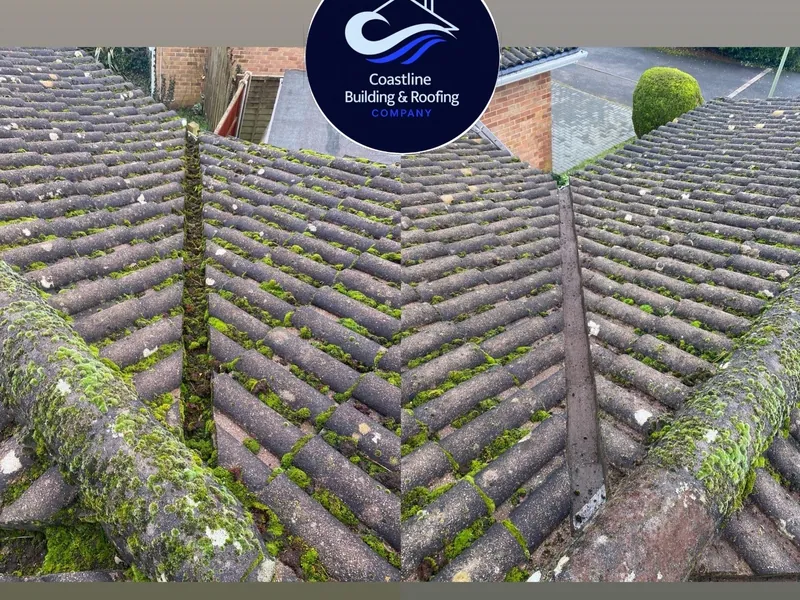
Roof cleaning work
- Hand scraping and brushing of moss and lichen
- Full clearance of valleys and secret gutters
- Gutter and downpipe clearing
- Removal of debris from the roof and grounds
- Biocide treatment to slow regrowth where suitable
- Inspection of the covering while access is up
- Reporting on any tiles found cracked or slipped
When a roof needs clearing
Thick green growth across the pitch
Especially on north-facing slopes. It is holding water against the tile through every frost.
Moss in the gutters and at the downpipe
It has already come off the roof and is now blocking the drainage.
A valley you cannot see the metal of
The valley is the busiest part of the roof for water. Silted up, it backs water under the tiles.
Spalling or flaking tile faces
Frost damage that moss accelerates. Worth clearing before more tiles go.
Damp on an upstairs wall after heavy rain
Can be a blocked valley or gutter overflowing rather than a failed roof.
Why jet-washing a roof is a false economy
A pressure washer removes moss quickly and convincingly, which is why it is so widely offered. The problem is what else it removes. Concrete tiles are finished with a bonded surface layer that gives them their colour and much of their weather resistance, and a lance takes that off along with the moss. The tile is left porous, so it soaks up more water and mosses up faster than before.
The second problem is water getting in during the clean. A roof is designed to shed water running downhill under gravity, not water driven uphill at pressure. A lance pushes water straight up under the laps, past the tile and onto the underlay, and on an older roof with perished felt that goes into the loft. People often report a new leak in the weeks after a jet-wash.
Slate and clay have their own problems with it — slate can split along its cleavage plane, and old clay can lose its face. Hand clearing takes longer and costs more in labour, but it is the only method that does not shorten the life of the roof it is meant to be maintaining.
Roof Cleaning — common questions
Do you jet-wash roofs?
No, and deliberately not. Pressure washing strips the surface off concrete tiles, forces water under the laps and can split slate. Coastline clear moss by hand, which takes longer but does not shorten the life of the roof.
Will the moss grow back?
Some regrowth is normal in a damp coastal climate, particularly on shaded north-facing slopes. A biocide treatment after clearing slows it considerably, and keeping the valleys and gutters clear matters more for the roof than the appearance of the tiles does.
Is moss actually damaging my roof?
It can be. It holds water against the tile through frosts, which spalls concrete over time, and it blocks valleys and gutters, which backs water up under the covering. A light growth on a sound roof is not an emergency.
Can you clear the gutters at the same time?
Yes, and it is worth doing together — most of what blocks a gutter came off the roof, so clearing one without the other means it silts up again.
More questions
About working with Coastline
Do you work on commercial as well as domestic roofs?
Yes. Alongside houses, Coastline work on flat-roofed commercial buildings, shop and flat conversions and outbuildings across Bournemouth, Christchurch and Poole.
Can you match the existing roof on a semi or terrace?
Usually. Most concrete and clay profiles are either still in production or have a close current equivalent, and reclaimed stock is an option for older slate. Matching the neighbouring property is worth raising at the estimate stage.
Do you replace roofing felt under the tiles?
Yes. Replacing perished bitumen felt with a modern breathable underlay means stripping the covering, so it is normally done as part of a re-roof rather than on its own — though a single elevation can be done where that is what has failed.
Can you check a roof before I buy a house?
Yes. A pre-purchase roof inspection is a sensible thing to have done, particularly on an older property where the survey has flagged the roof but not said how serious it is.
Do you work at height on flats and taller buildings?
Yes, with appropriate scaffold and access. The access arrangement is part of the estimate, so you know what is included before work starts.
What happens to the waste from my old roof?
It is removed from site as part of the job. Coastline's customers consistently mention how tidy the site is left, which is something the team take seriously.
Not sure which of these you need?
Describe the problem and Coastline will tell you. The inspection is free, and so is being told it is only a repair.